
Corundum
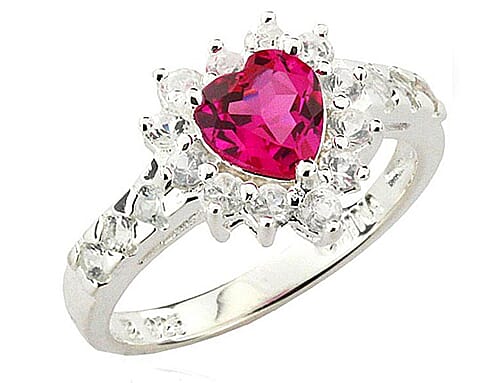
This superlative family of gems, with their array of absolutely stunning colours, are extremely popular for use in jewellery. Many corundum gems are appealingly affordable while retaining the outstandingly opulent beauty of costlier stones, however the finest quality rubies and sapphires have always commanded premium prices.
Origin and Supply of Corrundum
The word ‘corundum’ is derived from the Tamil ‘kurundum’, meaning ‘ruby sapphire’. Transparent varieties are used as gems in the jewellery industry – they are called ruby if red and padparadscha if pink-orange. All other corundum colours are labelled as sapphire, such as ‘green sapphire’.
Optical Features
Corundum for use in jewellery has a gorgeous ‘adamantine’ (bright, steely) lustre. The sapphire variety changes colour wonderfully depending on the light source, whereas ruby corundum obtains an added fluorescence under the ultraviolet rays of the sun.
Corrundum Buyers Tips
Gem quality corundum with few inclusions looks most beautiful when faceted, while lower-grade varieties with more flaws are best designed as cabochons or beads.
Since corundum is the second hardest mineral on earth, it handles daily wear and tear extremely well.
Naturally occurring, unheated gems are extremely rare and thus extremely expensive, since their colour and clarity cannot be surpassed by treated corundum.
Conclusion
The corundum family present some the most exquisite and magnificent gems available on earth. With their translucent stellar sparkle and range of rich dazzling colours, these gorgeous minerals will never lose favour amongst jewellery designers and enthusiasts alike.
Gem Specs
 |
Colour | Pink, Red, Blue, Orange |
| Crystal Structure | Trigonal | |
| Sources | India, Myanmar (Burma), Russia, Zimbabwe, and South Africa. |